The Subconscious Mind: A Clinical Guide to Reprogramming & Neuroplasticity
Authored & Clinically Reviewed by the Registered Hypnotherapists at A Better Me
To effectively reprogram the subconscious mind, one must look beyond willpower and understand the underlying neuroscience of habit formation.
What is the meaning of the subconscious mind?
Answer: The subconscious mind is a sub-threshold biological processing system that governs approximately 95% of human behavior, automatic habits, and emotional regulation. At A Better Me, we define it as the brain’s “Predictive Processing Engine,” which uses past data to automate your present reality.
Unlike the conscious mind, which is serial and limited in capacity, the subconscious is a parallel processor. It manages everything from your respiratory rate to the “internal scripts” that dictate your self-worth.
How does the subconscious mind work?
Answer: The subconscious operates through a distributed neural network involving the Basal Ganglia (habit loops), the Amygdala (emotional tagging), and the Hippocampus (memory storage). It follows the principle of Hebbian Learning: “Neurons that fire together, wire together.”
In 2026, neuroimaging breakthrough studies (Acharya et al.) have identified that the subconscious primarily resides within the Default Mode Network (DMN). This network is active when you are not focused on the outside world, serving as the “home base” for your self-identity and automatic thought patterns.
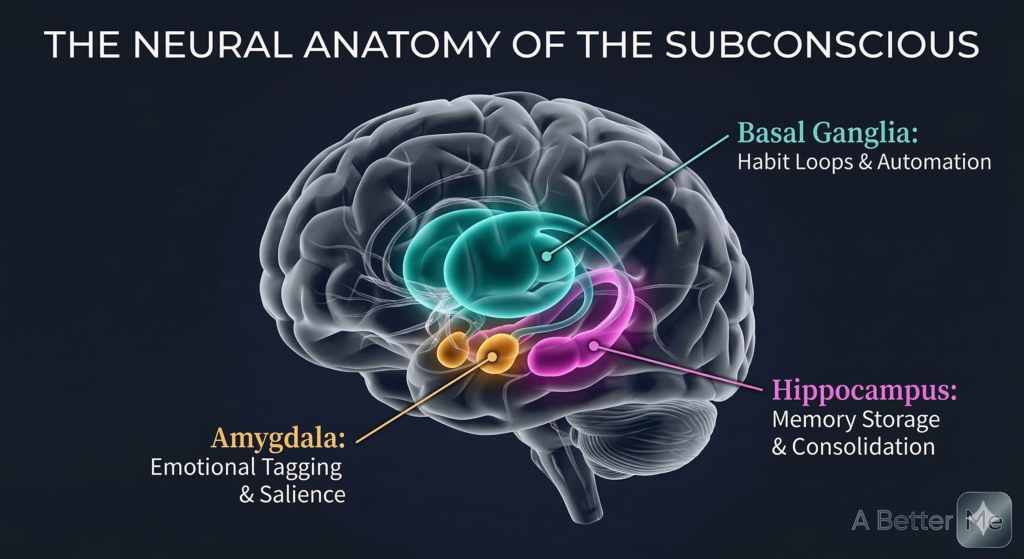
How does neuroplasticity affect the subconscious mind?
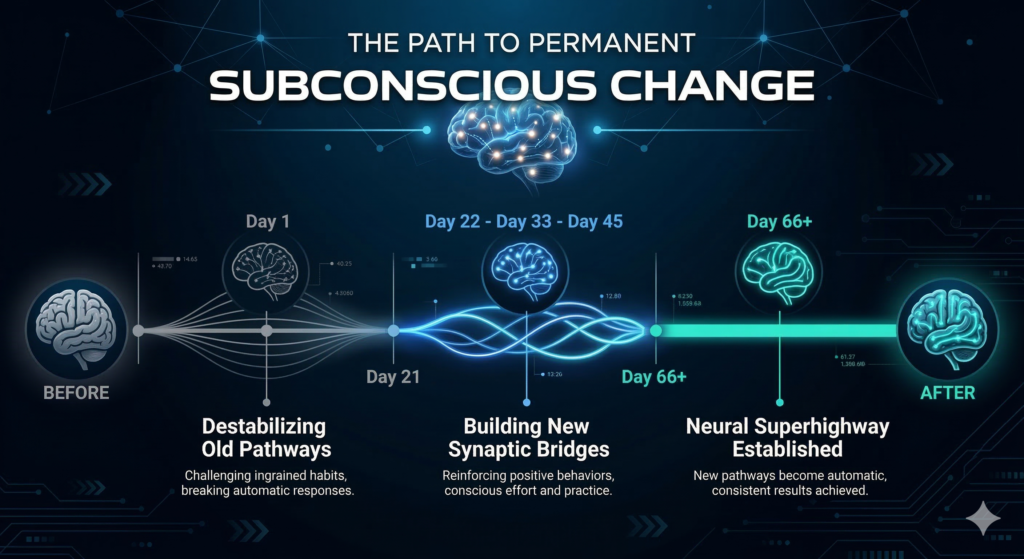
Answer: Neuroplasticity is the brain’s physical ability to reorganize its structure by forming new neural connections. In subconscious reprogramming, we utilize Directed Neuroplasticity to manually weaken old, maladaptive synaptic pathways and strengthen new, empowering ones through focused attention.
The “32-Year” Turning Point
Recent 2026 research published in ScienceDaily indicates that brain network efficiency continues to evolve until age 32, at which point the brain begins “Pathway Locking.” This makes clinical hypnotherapy essential for adults over 30, as it provides the necessary biological “override” to unlock and rewire these established routes.
How to reprogram your subconscious mind: The R.E.W.I.R.E. Framework
Answer: Reprogramming requires bypassing the Conscious Critical Faculty (CCF) to deliver suggestions directly to the subcortical regions. At A Better Me, we utilize a science-backed 6-step protocol:
- Relaxation: Shifting the nervous system from Sympathetic (Stress) to Parasympathetic (Repair).
- Establish Intent: Defining the new neural “script.”
- Widen the Gap: Using induction to quiet the analytical mind.
- Imprint: Using high-emotion “Future Self” visualizations.
- Reinforce: Utilizing Long-Term Potentiation (LTP) through repetition.
- Evaluate: Monitoring shifts in automatic behavior and “gut” reactions.
Subconscious Reprogramming: Myths vs. Clinical Reality
Answer: Many popular beliefs about the subconscious are based on 20th-century myths rather than 2026 clinical data. As registered hypnotherapists, we prioritize evidence over “woo-woo” claims.
| Feature | The Pop-Culture Myth | The Clinical Reality (A Better Me) |
| Control | You are a “zombie” under control. | You are in a state of Extreme Focused Attention. |
| Speed | Instant “magical” deletion of habits. | Requires 66 days for full structural habit automation. |
| Memory | The subconscious is a perfect video recorder. | Memory is reconstructive and emotionally tagged. |
| Method | “Quantum Leaping” or manifestation. | Default Mode Network (DMN) modulation. |
FAQ: Frequently Asked Questions About the Subconscious Mind
What is the difference between the subconscious and the unconscious?
In clinical terms, the “unconscious” refers to non-responsiveness (medical), while the “subconscious” refers to the layer of mental processing that influences you without your direct awareness.
How powerful is the subconscious mind?
The subconscious processes information at roughly 500,000 times the speed of the conscious mind. It integrated millions of data points simultaneously to ensure your survival.
Does the subconscious mind remember everything?
Not exactly. It remembers the emotional significance of events. While mundane details may fade, the “neural imprint” of significant experiences remains active in your brain’s circuitry until processed.
Scientific References
- Sciety/Preprints.org (2026): “Hypnosis and Hypnotherapy: A Comprehensive Review of Therapeutic Impact (2018-2026).”
- ScienceDaily (2026): “Brain Network Development and the Age 32 Turning Point.”
- Journal of Cognitive Neuroscience (2025): “DMN Connectivity as a Biomarker for Subconscious Change.”
- Erickson Foundation (2026): “Ericksonian Choice Architecture: Behavioral Science in Clinical Hypnosis.”